
English| EUR
Suggested for you
More currencies
Choose a language
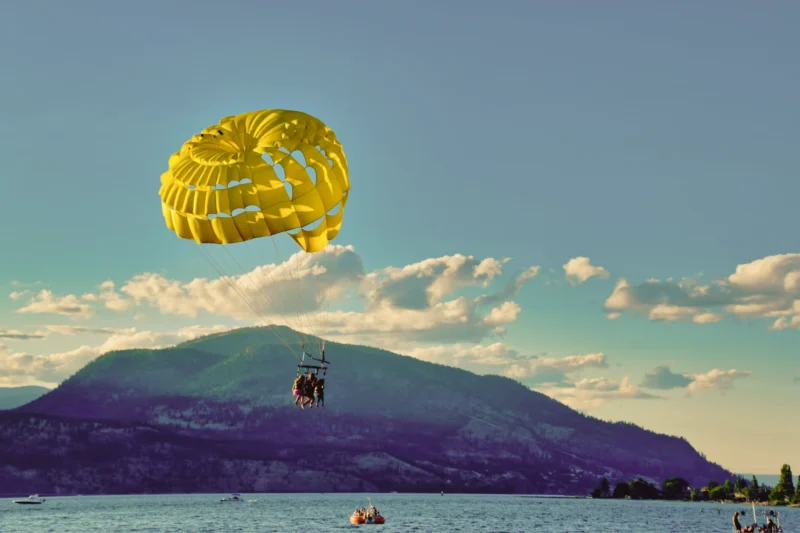
From the beach at Kerry Park, a parasail canopy climbing above Okanagan Lake looks like the riskiest thing on the downtown Kelowna waterfront. In practice it is one of the most controlled. This is parasailing safe guide covers the harness and towline setup, who actually flies the canopy, and the conditions that change the answer.
Quick answer
Yes. Commercial parasailing on Okanagan Lake is a low-impact activity: riders are winched off and back onto a padded flight deck, strapped into a harness, and most stay dry unless they request a dip. Flights run daily, 10:00–20:00, and the controlling variable is wind — crews ground flights when the lake turns choppy.
A parasailing passenger steers nothing. The canopy carries no passenger-operated control lines; altitude, speed and direction belong to the winch operator and the boat captain. That single design choice explains much of what people are really asking when they ask is parasailing safe. The rider is cargo, suspended under a spinnaker-shaped canopy on a towline, while two trained crew manage the variables. Context matters too. Okanagan Lake runs roughly 135 kilometres through the southern interior of British Columbia, and the stretch off Kerry Park on the downtown Kelowna waterfront is sheltered, deep and free of surf. There is no tidal swell and no reef. Flights launch and land from a padded deck at the stern of the winch boat, so riders are clipped into a harness and a personal flotation device while standing still. Canadian commercial towboats operate under Transport Canada vessel requirements, and a reputable Kelowna parasailing operator carries liability coverage, radio contact and a crew that briefs every rider before the towline pays out. The residual risk sits in two places: hardware and conditions. Industry incident reviews worldwide point to worn towlines, fatigued harness hardware and flights pushed into rising wind rather than to the act of flying itself. Both are operator-controlled, which is why the question of who runs the boat matters more than the question of whether the sport is dangerous. Equipment is inspected on a schedule. Wind is read off the water, and a flight that should not go does not go. For visitors, the practical use of all this is a short list of questions. How old is the towline. What wind speed grounds a flight. What are the weight ranges for a single rider and for a tandem parasail ride. A crew that answers quickly and specifically is a crew that tracks its own equipment. Medical limits are worth raising at booking rather than on the dock, since pregnancy, recent surgery, back and shoulder injuries and some heart conditions rule out a flight. Children generally fly tandem with an adult. Anyone asking is parasailing safe before a first flight over Okanagan Lake will usually find the honest answer is yes, with conditions attached — and the booking pages on this site list the flights currently running from the downtown waterfront.
“The rider is cargo; altitude, speed and direction belong to the winch operator and the boat captain.”
Common concerns regarding parasailing often stem from outdated perceptions or lack of information about modern aviation standards. Industry regulations and specialized equipment have transformed the activity into a highly controlled experience.
MythParasailing relies on unpredictable winds and lacks control.
FactModern parasailing uses professional winch-boat systems that maintain consistent tension and allow operators to control flight height precisely.
MythEquipment failure poses a major risk to participants.
FactParasailing equipment is subject to strict maintenance schedules and rigorous safety inspections to meet regulatory standards.
MythYou need athletic ability or training to participate.
FactParasailing is a seated activity that requires no prior experience or physical exertion from participants.
A standard Okanagan Lake parasail flight follows a fixed sequence that keeps a certified crew in control of every transition between boat deck and open air. From check-in at the Kerry Park dock to standing back on the deck, the whole process runs roughly 60 to 90 minutes, with about 10 to 15 minutes of that spent airborne.
Report to the crew at Kerry Park, Downtown Kelowna Waterfront, Kelowna, BC, Canada and confirm your weight with the captain. People round their weight down to seem flight-ready, but the crew uses real numbers to set canopy size and rider pairing, so an inaccurate figure gets corrected on the scale anyway.
The mate walks the group through hand signals, seated launch posture, and what to do if the wind shifts. Riders often tune out because the talk sounds routine, then miss the single signal that matters most: the thumbs-down that means the crew is reeling you in.
A crew member tightens the leg loops and chest strap, then checks the fit by pulling against it while you stand. Do not loosen anything for comfort once it is set; a slack leg loop is the most common reason a rider slides in the harness and feels unstable in the air.
The mate attaches your harness to the spreader bar and the canopy riser, then verbally confirms the carabiner is locked. Keep both hands clear of the bar during this step rather than gripping it; the crew needs an unobstructed view of the gate.
Stay seated on the flight deck with legs extended until the captain throttles up and the canopy lifts you off. Standing early is the usual mistake and forces the crew to abort and reset the launch.
Once at altitude the winch holds your line length while the captain circles the lake. Glance back at the boat periodically instead of fixing on the horizon, since all communication from the crew happens visually from the deck.
The winch draws you in and the mate guides you down by the harness as you keep your knees bent and feet together. Reaching for the deck with your legs too soon is what causes an awkward touchdown; let the crew take your weight first.
Wait for the mate to release the carabiner and remove the harness before moving. Riders step away while still partly clipped in, which tangles the line for the next flight and delays the rotation.
The best arrival window is 10:00–12:00, as morning hours consistently provide the calmest, safest weather conditions on Okanagan Lake. Scheduling flights early helps avoid the typical afternoon wind increases that can affect water stability.
Warm 28°C; calm morning air
High demand makes early booking essential for morning flights.
Mild 22°C; stable conditions
These months offer reduced crowds and reliable flying weather.
—
This window minimizes wait times and offers the most predictable lake conditions.
Verdict: The optimal time to visit is during weekday mornings in June or September, arriving at the 10:00–12:00 window.
The cost of parasailing on Okanagan Lake depends on the number of participants sharing the flight. Rates are set per person based on single, tandem, or triple flight configurations.
Verdict: An adult typically pays 149 CAD for a single flight, with costs decreasing to 89 CAD per person when flying in tandem or triple groups.
The parasailing service operates on a consistent daily schedule throughout the season to ensure regular access for visitors.
The parasailing departure point is located at Kerry Park along the Downtown Kelowna waterfront. Visitors can easily reach this central location via major city streets or by walking through the downtown core.
Highway 97 to Abbott Street, Downtown Kelowna
Route 97 towards Downtown Kelowna Exchange
Walk towards the waterfront via Bernard Avenue
The best arrival window is 10:00–12:00, as mornings typically offer better water conditions. Utilize public parking near the waterfront to ensure timely access to your scheduled departure.
Most of what keeps a parasailing flight smooth is settled before you reach the dock, so work through these in order.
Everything you need to know about is parasailing safe
Yes, parasailing is safe for beginners as it is a highly regulated activity managed by experienced professionals. When wondering if parasailing safe practices are followed, look for certified crews that use modern equipment and rigorous pre-flight checks.
Operators ensure safety by utilizing specialized boats and high-strength harnesses designed to handle aerial tension securely. Many visitors ask is parasailing safe before arriving, and the standard answer involves professional instruction and constant communication with the flight crew.
Parasailing requires specific wind and water conditions to remain safe, so trips may be delayed or rescheduled if conditions are poor. Assessing if parasailing safe parameters are met is the responsibility of the captain, who monitors lake conditions throughout the day.
Safety protocols generally require participants to meet specific weight thresholds to ensure the canopy functions correctly. While considering if parasailing safe limits are met for your group, please consult the official site for current requirements regarding tandem or triple flight configurations.
Flying with children is common, provided they meet the minimum age and weight requirements established by the operator. If you are debating if parasailing safe for younger participants is a concern, note that harnesses are adjustable and secured by trained staff.
To ensure your safety, follow all instructions provided by the crew during the briefing and wear your life jacket at all times. Understanding that is parasailing safe depends on both operator standards and passenger compliance will help you have a smooth experience on Okanagan Lake.